Trail guide
The 5 most spectacular waterfalls in Aosta Valley
From the famous Lillaz falls in Cogne to the hidden cascades of Mascognaz, Isollaz and Niel: five Aosta Valley waterfalls reachable on foot, with linked trails and best season.
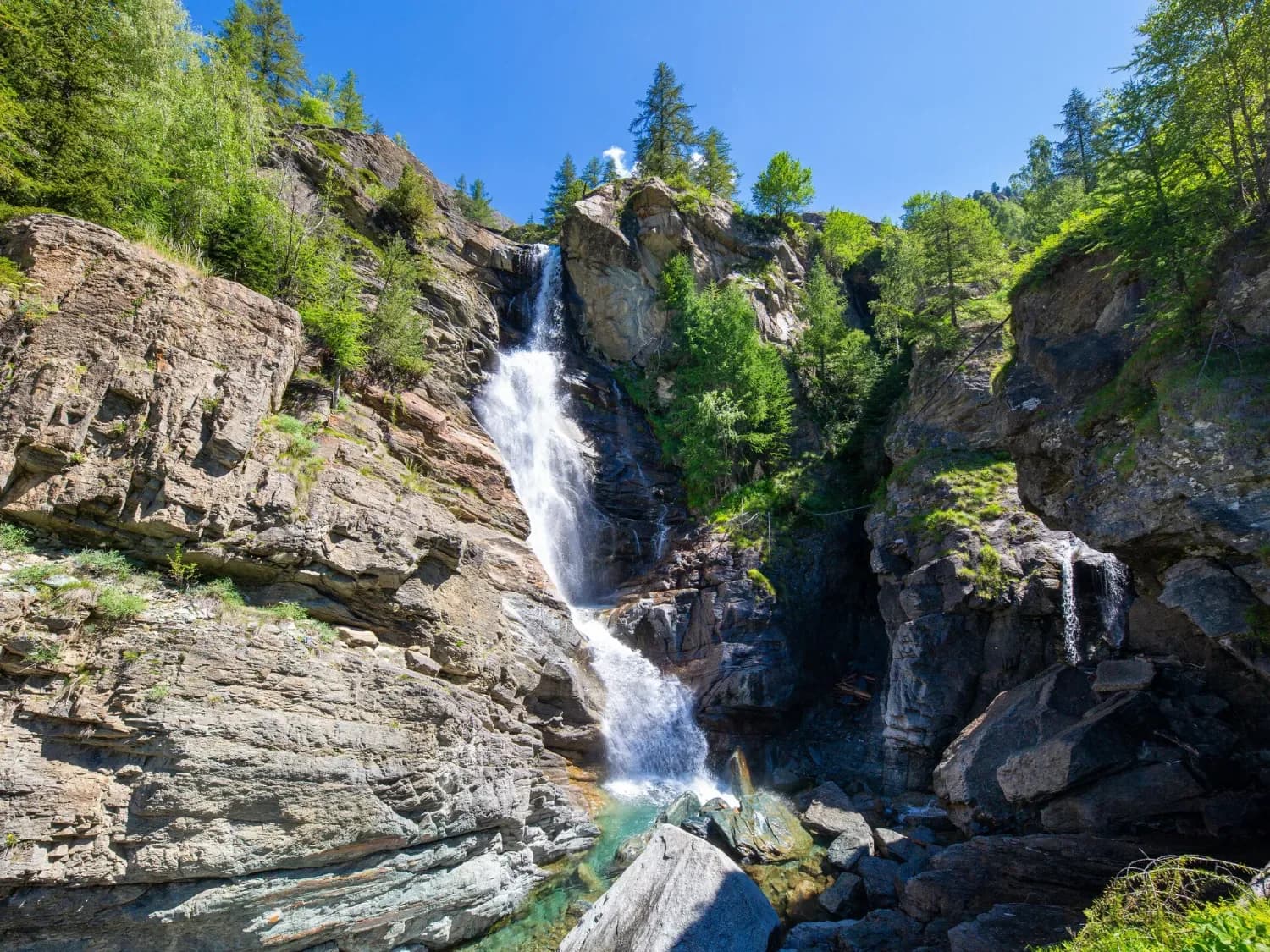
When the high-altitude glaciers and snowfields begin to melt, the Aosta Valley fills with the sound of water. The streams that tumble steeply down from the glacial cirques meet rocky steps, vertical drops and gorges carved over millions of years: this is how waterfalls are born — some monumental and famous, others hidden in side valleys that few people know. Reaching them on foot is one of the most immediate and rewarding ways to experience the mountains of the Aosta Valley, perfect even for those who aren't looking for big climbs.
This guide presents five waterfalls reachable via official trails from the Sentieri VdA catalogue, chosen for their spectacle, variety and accessibility — and all different from the destinations in our other guides. They range from the great cascade system of Lillaz, a true natural monument, to the hidden threads of water reachable in just a few minutes' walk. Each waterfall has its best moment: generally late spring and early summer, when the meltwater flow is at its peak.
Water makes the rocks near the falls slippery. Always keep a safe distance from the edges and pools, never climb over the barriers, and don't underestimate the force of the current at fording points.
1. The Lillaz waterfalls — the monument of Cogne
The Sylvenoire–Lillaz waterfall trail leads to the most famous cascade system in the region: the Urtier stream plunges through a series of spectacular drops framed by the forest, just steps from the hamlet of Lillaz, in the municipality of Cogne. At just 4.1 km and +218 m of elevation gain (difficulty T), it's the perfect destination for everyone: families, beginners, or anyone with only half a day to spare.
The ideal period runs from spring to autumn: in May and June the flow is impressive, while in autumn the larches around the falls blaze with yellow. The trail, short and well marked, lets you get close to the different tiers of the waterfall. It's the classic starting point for then discovering the Gran Paradiso Park and the Cogne valley.
2. Mascognaz waterfall — the cascade above Champoluc
From Champoluc, in Val d'Ayas, the trail to the Mascognaz Waterfall climbs in just 1.6 km (+255 m, E) towards one of the most evocative side valleys in the Monte Rosa district. The Walser hamlet of Mascognaz, reachable only on foot, holds a cluster of wood-and-stone chalets among the best preserved in the Alps: the waterfall is the natural frame of this timeless corner.
The climb is short but steep. The reward is twofold: the waterfall and the Walser hamlet, where traditional architecture and silence tell the story of the Alemannic culture of the upper Lys Valley and its slopes. The recommended season is summer, when the trails are clear and the alpine pastures are active.
3. Isollaz waterfall — the cascade a few steps from the road
The Isollaz Waterfall, near Challand-Saint-Victor in Val d'Ayas, is proof that you don't need hours of walking for a water spectacle: 1.3 km, almost flat (E), make it accessible to practically everyone. The drop, fed by the stream descending from the side valleys, is particularly scenic in the months of higher flow.
It's the ideal waterfall for a stop along the way up the valley, to combine with a visit to the castles and villages of the lower Val d'Ayas. A "hit-and-run" itinerary that nonetheless delivers the thrill of a great waterfall — perfect with children.
4. Niel waterfalls — the village of water
In the Niel valley, the short trail to the Niel Waterfalls — just 0.6 km and +80 m, E — leads you before the cascades that bring life to one of the most intimate and authentic alpine hamlets in the area. It's a minimal destination in terms of elevation but maximal in atmosphere: stone houses, bridges, the constant sound of water.
The shortness of the route makes it perfect as a stage in a fuller day or as a walk for everyone. Summer is the best time, when the village is alive and the meadows are in bloom. A little gem for those who love hidden, little-frequented corners.
5. The Glacier waterfall — the water and the bivouac
For fitter hikers, the trail from Glacier to the Rosazza/Savoie Bivouac along the waterfall, in Valpelline, is a demanding climb — 5 km for +1117 m, difficulty E — that follows the stream and its drops up to high altitude, in the municipality of Oyace. Here the waterfall isn't the destination but the travelling companion: the trail runs alongside it as it gains altitude towards the bivouac, in an increasingly severe and glacial setting.
It's the itinerary for those who want to combine the spectacle of water with the experience of the wild high mountains of Valpelline. To be tackled in summer and early autumn, with good fitness, suitable equipment and attention to the weather: the altitude and the elevation gain demand respect.
When to go, how to photograph them
The Aosta Valley waterfalls are at their best during the melt season, between late May and July, when the flow is at its peak. For photographs, the diffuse light of a slightly hazy day is preferable to full sun, which burns out the whites of the water; a long exposure, possible at dawn or in shade, captures the "silky" effect of the cascade. Above all technical considerations, safety remains paramount: the water is icy and powerful, the rocks slippery. Always check each trail's page for difficulty and season before setting out.