Trail guide
Aosta Valley hikes with the most spectacular sunrises
Where to watch the finest sunrises in Aosta Valley — Planaval, Champorcher, Arpy, Chamolé and AV ridges.
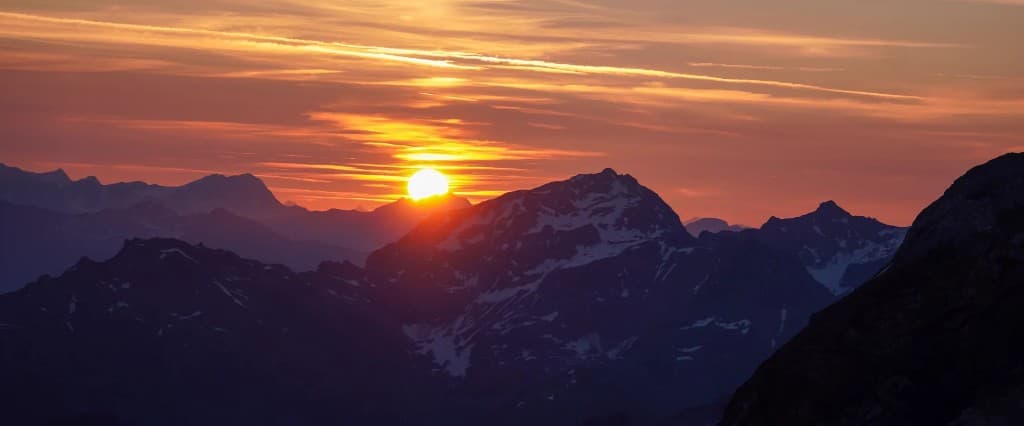
Getting up at half past four on holiday isn't for everyone. But in Aosta Valley a sunrise at altitude can be worth more than a week of sunsets in the city — not as brochure rhetoric, but because the region's geography concentrates into a few hours what elsewhere takes days: rosy alpenglow on Mont Blanc, valley mist that parts like a curtain, the first rays on the Matterhorn and the Gran Combin, lakes mirroring peaks still lit while the valley floor is dark.
The alpine sunrise isn't a guaranteed spectacle. It depends on the weather, the season, the patience of those who climb in the dark with a torch and thermal layers. This guide gathers eight itineraries from the Sentieri VdA catalogue where an early start truly pays off — with stories, context and practical advice beyond the departure times.
Rhêmes and Planaval: pastures in raking light
The Rhêmes valley — the wildest on the Alta Via 2 — guards pastures where the morning's raking light traces long shadows on Monte Grauson and the peaks of the eastern Gran Paradiso. Planaval, a Walser hamlet suspended between woods and meadows, is the ideal starting point for those who want a sunrise without necessarily tackling EE stages.
Stage 5 of the AV2, Planaval–Chalet de l'Épée crosses twelve kilometres and almost a thousand metres of positive elevation gain at difficulty E. Leaving Planaval at four in the morning in July means reaching the high pastures with the sun still low on the horizon — the hour when every blade of grass turns to a thread of gold. The Rifugio Chalet de l'Épée, the stage's destination, lets you stay overnight and repeat the experience the next morning without climbing back up from the valley floor.
Champorcher and the Crest Damon: the east of the region
Champorcher looks towards the Pennine Alps and the Piedmont side. Stage 13 of the AV2, Champorcher–Crest Damon is an EE day of eighteen kilometres — demanding, but among the few that deliver sunrises over the Pennines in absolute silence before seven. The Crest Damon, a pass and ridge, is exposed to the east: when the sky is clear after a front, the alpenglow lights the peaks in sequence, from pink to orange to dazzling white.
Stage 14, Crest Damon–Donnas closes the AV2 with an eighteen-kilometre descent towards Donnas — difficulty E, around seven hours. If you stay overnight at the Damon or nearby, the next morning's descent in oblique light is an experience distinct from the sunrise on the ridge: woods waking up, vineyards emerging from the mist towards the lower valley.
Combin de Tsessiöne–Oyace: alpenglow on the Combin
The Tour of the Gran Combin crosses the Valpelline with an austere grandeur. Stage 4, Combin de Tsessiöne–Oyace exposes ridges to the east: fourteen kilometres, difficulty EE, a descent of over a thousand metres towards Oyace. The red dawns on the Gran Combin, when the sky is clear after an unstable front, are among the most intense in the region — the massif lights up before the valley below emerges from shadow.
This stage requires preparation: a sure footing on the descent, navigation, respect for the weather. It isn't an outing for families, but for hikers who accept the contract of the alpine sunrise: effort in the dark, reward in uncertainty.
Veulla and the Col du Lac Blanc: a morning mirror
The Veulla–Col du Lac Blanc trail leads in seven and a half kilometres — difficulty E, over a thousand metres of positive elevation gain — to a basin often still at dawn. Reflections and mist coexist until eight in the morning; the Col du Lac Blanc dominates the central valley with views that include Monte Emilius and the peaks of the Ayas valley. Leaving Veulla at four in summer lets you arrive while the light is still oblique — and with a greater chance of finding still water.
Saint-Grat and Lac de Chamolé: an accessible sunrise
Not every sunrise requires EE. The Ermitage Saint-Grat–Lac de Chamolé is an accessible classic — three and a half kilometres, difficulty E — for families and hikers who want a morning experience without exposed ridges. Lake, meadow and peaks lighting up gradually: here Champorcher offers its gentlest face. Leaving at half past five lets you reach the lake in time for first light; the descent to Brusson for an Aosta Valley breakfast amplifies the urban-mountain contrast that stays in the memory.
Arpy–Pierre Rouge–Mont Cormet: a pink Mont Blanc
The Lac d'Arpy–Lac de Pierre Rouge–Mont Cormet trail exposes east-facing slopes with a view of the Mont Blanc massif. Four and a half kilometres, difficulty E, an ascent of almost a thousand metres: among the sunrises most cited by Aosta Valley's professional photographers. Lac d'Arpy at dawn is already iconic; climbing towards Pierre Rouge and Cormet adds perspective and isolation — fewer people, the same light.
Promoud–Planaval: valley mist
Stage 4 of the AV2, Promoud–Planaval crosses areas where the mist parts in layers — the "sea of clouds" effect frequent at dawn in Valgrisenche. Fourteen kilometres, difficulty E: not a short outing, but an immersion in a weather phenomenon that turns the mountain into theatre. When the mist lifts, the peaks emerge one after another — a slow, unpredictable, unforgettable spectacle.
Checklist and when to skip it
Sunrise checklist: headtorch with a spare battery, thermos with hot tea, thin gloves (even in July on the ridge), a weather check the evening before — low clouds on the valley floor mean disappointment at altitude.
When it's NOT worth it: after an unstable front (a beautiful sky but strong wind on the ridge), with children under ten unaccustomed to the dark and the morning cold, without an adequate torch or with uncertain forecasts.
A "sunrise + breakfast" combo: Saint-Grat–Chamolé in the morning, then the descent to Brusson. The contrast between alpine silence and village noise amplifies the memory of the sunrise — not as a curiosity, but as an experience that justifies the early alarm.
The science of alpenglow
Alpenglow — that pink-orange light that ignites the peaks before the sun reaches the valley floor — isn't magic: it's atmospheric scattering. Low-angle sunlight passes through more atmosphere, filtering out the short wavelengths (blue) and leaving red and orange to dominate. In the mountains, with clear air and east-facing peaks, the effect is amplified. The trails we've selected share one trait: eastern exposure or a ridge position facing the horizon where the sun rises.
Understanding this mechanism helps with planning: there's no need to get up at three if your destination faces west; there is, however, a need for iron punctuality if you want to capture the Arpy or the Crest Damon with pure alpenglow.
Rhêmes Notre-Dame and the slow rhythm
Planaval and Rhêmes Notre-Dame belong to a valley that the AV2 crosses almost in its entirety — but few know its individual place names. Stage 4 Promoud–Planaval and Stage 5 Planaval–Chalet de l'Épée form a natural pairing for two consecutive sunrises: first the mist parting in Valgrisenche, then the pastures lit towards the Grauson. Staying overnight at the Chalet de l'Épée means waking up already at altitude — a privilege that alone justifies the booking.
Champorcher: two faces of the same sunrise
Champorcher offers the accessible register (Saint-Grat–Chamolé) and the demanding one (Champorcher–Crest Damon and Crest–Donnas). Families with children used to walking can opt for Chamolé; experienced hikers can aim for the Crest. Both face east; both reward those who set off in the dark.
Arpy and the central valley
The central valley — Morgex, Arpy, La Salle — is often overlooked compared with Courmayeur and Cervinia. Yet the 44-s25 trail and the 17-s6 from Veulla offer sunrises over Mont Blanc and Emilius with an accessibility the "premium" valleys don't always have. Easier parking, fewer people, the same light.
Combin and Valpelline: for the few
Stage 4 of the Tour du Gran Combin, Tsessiöne–Oyace closes this guide with the most demanding proposal: EE, ridges, a long descent. The sunrise here isn't "consumed" in an hour — it's lived through an entire morning of descent in oblique light. Only for prepared legs and minds.
A practical plan: three sunrises in a long weekend
Friday evening: arrival in Planaval, weather check. Saturday 04:00: Promoud–Planaval or the climb towards Chalet de l'Épée. Saturday evening: move to Champorcher. Sunday 05:00: Saint-Grat–Chamolé, breakfast in Brusson. Two sunrises, two valleys, zero repetition.
Equipment for the alpine sunrise
Beyond torch and layers, consider these indispensable: a food warmer or thermos (the body burns calories while waiting for the light on the ridge), energy bars (an early breakfast at four won't last until midday), thin gloves even in July — the ridges of the AV2 and the Combin reveal an icy wind at six in the morning even with 25°C forecast in the valley.
Boots already laced the evening before, backpack ready, water in an insulated bottle if possible: every minute stolen from sleep counts when departure is at 04:00.
Weather: when to stay in bed
Persistent low clouds on the valley floor, a forecast of rain after 10, strong wind at altitude flagged by the models — three signals to postpone. The best sunrise is the one you wait for safely the next day. The mountain doesn't expire; the weather does.
Summary: the eight sunrise trails
For those who prefer a checklist woven into the narrative: Planaval–Chalet Épée, Champorcher–Crest Damon, Crest–Donnas, Combin Tsessiöne–Oyace, Veulla–Col du Lac Blanc, Saint-Grat–Chamolé, Arpy–Cormet, Promoud–Planaval. Eight possible sunrises — one for every weekend of the summer season, if you want to give the mountains the time they deserve.
Aosta Valley doesn't sell sunrises: it gives them to those who climb in the dark with respect and patience. The eight routes we've described — from Planaval to the Combin, from Veulla to Arpy — are invitations to discover that generosity.
Photo credits
- Cover (Alpine sunrise in Aosta Valley): Wikimedia Commons, CC BY — Sentieri VdA archive
- Crest Damon and Champorcher: regional trail catalogue, reworked by Sentieri VdA
- Lac d'Arpy and Mont Blanc alpenglow: mountain photo archive, free licence