Trail guide
The 5 best hikes in Gran Paradiso National Park
Guide to five must-do hikes in Gran Paradiso National Park — Valnontey, Djouan lake, Vittorio Sella, Dondena.
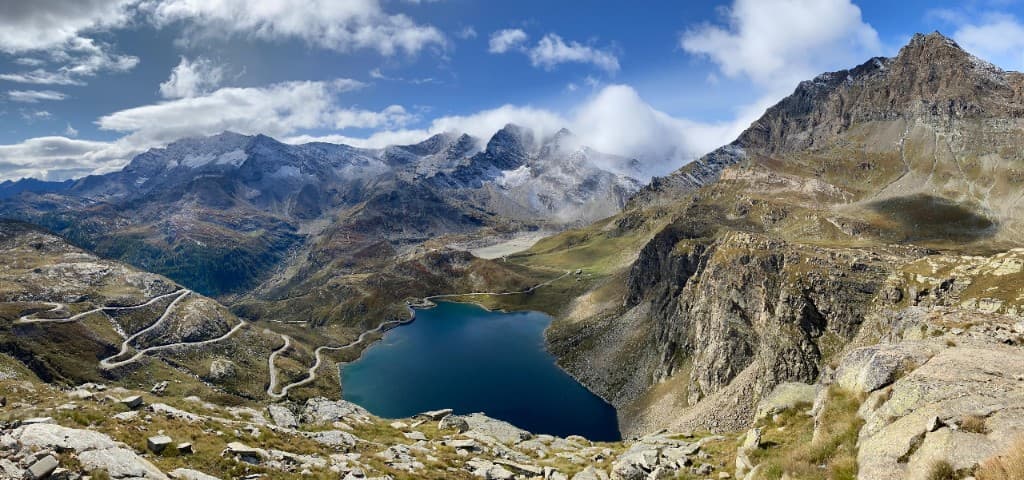
In 1922, when the Kingdom of Italy established the country's first national park, the choice fell on these valleys — not on a bureaucratic whim, but because here the boundary between civilisation and wilderness was still thin, and because the Alpine ibex survived just a few kilometres from the pastures of Cogne. The Gran Paradiso National Park was thus born: from a royal hunting reserve transformed into a sanctuary, from an idea of conservation that preceded modern environmentalism by decades. Today, a hundred years later, walking in the park still means sensing that original tension — larch woods giving way to glacial moraines, lakes suspended like thermometers of the glaciers' retreat, refuges that bear the names of explorers and photographers who imagined these mountains before they became a "destination".
Commercial guides almost always converge on Cogne, Valnontey and Lake Djouan. They are valid destinations — but the park is vast, crossed by two great traverses (the Tour del Gran Paradiso and the Alta Via 2) that cut through it on different diagonals. We have selected five hikes from the Sentieri VdA catalogue that tell the park in depth: not five lines to tick off, but five ways to inhabit, for a few hours — or a few days — one of the most authentic alpine landscapes in Europe.
Why Valnontey remains the heart of the park
Valnontey is not just a starting point: it's a microcosm. The valley narrows between walls of gneiss and meadows where the marmots whistle with nonchalance, then opens towards the glacial basins that feed the higher lakes. Here geology tells of centuries of glaciers that have shaped rocky amphitheatres; here history tells of shepherds, park rangers and the slow transition from Savoyard rule to public protection.
Stage 2 of the Tour Gran Paradiso, Valnontey–Lake Djouan is the park's quintessential hike — twelve kilometres, about 850 metres of positive elevation gain, difficulty E. It's not a stroll: it's a progressive climb that rewards those who accept the mountain's rhythm. The larches give way to the pastures; the water of the Djouan, when it finally appears, has that turquoise that no Instagram filter can invent — it's the signature of suspended glacial sediment. Many hikers stop here, and they're right: the lake is destination enough. But the park truly reveals itself to those who go beyond the postcard.
Beyond the Djouan: the descent towards Rhêmes
There's a frequent mistake among summer visitors: believing that the Gran Paradiso is "done" once you've seen its most photographed lake. In reality, the network of trails connects the Valsavarenche to the Rhêmes valley through passages that the CAI registers have marked for over a century. Stage 3, Lake Djouan–Eaux Rousses, with its ten kilometres and a negative elevation of about 900 metres, is the day that turns an excursion into a taste of multi-day trekking.
Eaux Rousses — "red waters", from the ferruginous colour of some streams — is a Walser hamlet suspended between two worlds. Spending the night here, or at the nearby refuge, means feeling the park when the tourist buses have already gone down to the valley. The morning light on the larches has a different quality: more oblique, more patient. Those who build a two- or three-day itinerary around Valnontey, Djouan and Eaux Rousses discover that the park's "classic" can also be the deepest — without any need for EE stages.
Vittorio Sella and the descent towards Cogne
If there's a name that inextricably links the Gran Paradiso to visual culture, it's Vittorio Sella. A photographer and mountaineer, he documented these valleys with photographic plates carried on his shoulders, in the years when "taking a photo" meant chemistry, darkness and patience. The Rifugio Vittorio Sella, at 2584 metres, is not just a hub of the Alta Via 2: it's a tribute to the man who taught the world to look at the Alps with respect.
Stage 5 of the Tour Gran Paradiso, Vittorio Sella–Cogne is a descent of eight kilometres and over a thousand metres of negative elevation — difficulty E, about two and a half hours for those with a sure step on the descent. The knee counts more than the lung. The trail crosses woods that smell of resin, crosses little bridges over streams that in summer seem harmless but conceal the fury of the spring floods, and descends to the village of Cogne with that satisfaction that only a long descent can give. Cogne, with its stone houses and the tradition of wrought-iron craftsmanship, closes the circle: from ice to village in half a day.
The same descent, another story: the Alta Via 2
There's a curious phenomenon in the great alpine traverses: stretches of shared trail that change meaning depending on the direction travelled and the "book" in which you read them. Stage 9 of the Alta Via 2, Vittorio Sella–Cogne coincides geographically with stage 5 of the Tour Gran Paradiso — the same kilometres, the same elevation — but those who tackle it as a stage of the AV2 carry the gaze of someone who has crossed the park from the east, from Courmayeur and Champorcher, through less-frequented valleys.
It's not about repetition: it's about perspective. The AV2 trekker looks at Cogne not as the destination of a day trip, but as an intermediate stage of a journey that will continue towards the lower valley. The landscapes are identical; the narrative is not. For anyone planning a customised traverse, this overlap is a gift: it allows you to combine the Tour Gran Paradiso and the Alta Via 2 without reinventing the cartography.
Champorcher and the stage towards Dondena
The eastern side of the park — the Champorcher valley — is the Gran Paradiso that many tourists never see. Less crowded than Cogne, wilder in the etymological sense of the word, it holds woods that shelter roe deer and, at dawn, ibex descending towards the pastures. Stage 11 of the Alta Via 2, Sogno di Berdzé–Dondena connects two refuges in seven kilometres of difficulty E: a short day for those walking the entire traverse, but a complete immersion for those who choose it as a standalone outing.
The Rifugio Sogno di Berdzé — the name evokes the area's Walser heritage — sits at an altitude that allows you to observe the movement of the wildlife without intruding on it. The Rifugio Dondena, lower down, is the gateway to trails that climb towards the Colle della Rosa dei Banchi. Walking between the two refuges means crossing the transition from forest to alpine meadow, from meadow to rock: a lesson in alpine ecology that can be walked at a human pace.
Wildlife, behaviour and responsibility
The ibex is the symbol of the park, but it's not a zoo actor. After decades of protection, the Alpine ibex approach the trails with a nonchalance that can be deceptive: they seem indifferent, but they react to the stress of getting too close. Keeping at least a hundred metres of distance, never feeding the wildlife, avoiding shouting or chasing for a photo — these are trivial rules until you're face to face with an adult male in autumn.
Dogs are often forbidden or strictly regulated in the park: always check the official site before planning. The park ranger you'll meet at the Djouan isn't being a moralist: he's applying rules born of real incidents.
An essential three-day itinerary
For those who have a long weekend and want to savour the park without EE stages, we propose a summary that uses three of the five stages mentioned:
Day one: climb from Valnontey to Lake Djouan, overnight in a refuge or return to Valnontey if you prefer the valley. Day two: Djouan–Eaux Rousses, overnight at Eaux Rousses or at the Rifugio Vittorio Sella if your pace allows. Day three: descent Vittorio Sella–Cogne, lunch in the village and return.
Three days, three valleys, zero repetition with the "top ten" rankings that fill travel magazines. The Gran Paradiso doesn't ask you to rush: it asks you to look.
Geology and the memory of ice
The park's lakes — Djouan, Money, Loie — are visible indicators of the glacial retreat. Comparing Vittorio Sella's archive photographs with the same viewpoint today is an exercise that turns hiking into climate reflection. The moraines that flank the trails are not decorations: they are the boundaries of glaciers that have vanished or are in retreat. Walking here with this awareness adds a layer to the landscape — not to frighten, but to honour the mountain as a living system, not as scenery.
Cogne, Valnontey and mountain culture
Before Cogne became a tourist destination, it was a village of miners and shepherds — the iron and copper mines have left traces in the place names and in the stone architecture that still defines the village today. Valnontey, higher up, chose another path: that of the park, of slow tourism, of hospitality that doesn't shout. Walking between the two means crossing not just kilometres but centuries of the human-mountain relationship. The refuges mentioned in this guide — Vittorio Sella, Sogno di Berdzé, Dondena — are not high-altitude hostels: they are nodes of a network that existed before GPS, when directions were asked for in dialect and time was measured in "hours of daylight".
The Tour del Gran Paradiso and the Alta Via 2 cross paths repeatedly in these valleys. You don't need to walk them in full to benefit from them: just steal a stage, two, three — and build a tailor-made itinerary. The Valnontey–Djouan stage works on its own; combined with Djouan–Eaux Rousses it becomes a micro-trek; inserted into a week of AV2 it becomes a chapter of a larger book.
Seasonality and what to bring
The park's trails are largely walkable from June to September, with variations linked to the snow cover on the high passes. At the start of the season, always check the Sentieri VdA pages for the state of the little bridges and the sections over residual snow — the Berdzé–Dondena stage and the descents towards Cogne can present snow patches until July in cool years. Trekking shoes with a Vibram sole or equivalent, thermal layers, sun protection and at least two litres of water for the long days are not optional.
For overnight stays in refuges: a sleeping bag liner is mandatory almost everywhere, a head torch, cash for small expenses. The park's refuges — the Sella first and foremost — must be booked weeks in advance in August; Champorcher and Dondena offer more flexibility.
The Gran Paradiso today
The park is not a museum: it's a living ecosystem, a laboratory of conservation, an inhabited territory. The five hikes we have described — Valnontey–Djouan, Djouan–Eaux Rousses, Sella–Cogne in two versions, Berdzé–Dondena — are gateways to a simple and radical idea: that Italy's first national park still deserves, after a century, to be experienced through the eyes of those who know how to wait. No hyperbole is needed. What's needed are hikers who walk slowly, respect the wildlife, stay overnight in the refuges and leave the valley cleaner than they found it.
Photo credits
- Cover (Ibex in the Gran Paradiso Park): Wikimedia Commons, CC BY-SA — Sentieri VdA archive
- Lake Djouan and glacial moraines: regional trail catalogue, Sentieri VdA reworking
- Rifugio Vittorio Sella: historic mountain photographic archive, public domain