Trail guide
The 10 most beautiful trails in Aosta Valley
Updated ranking of the ten most spectacular hikes in Aosta Valley — from the Bonatti balcony to Monte Rosa valleys, with verified trail pages.
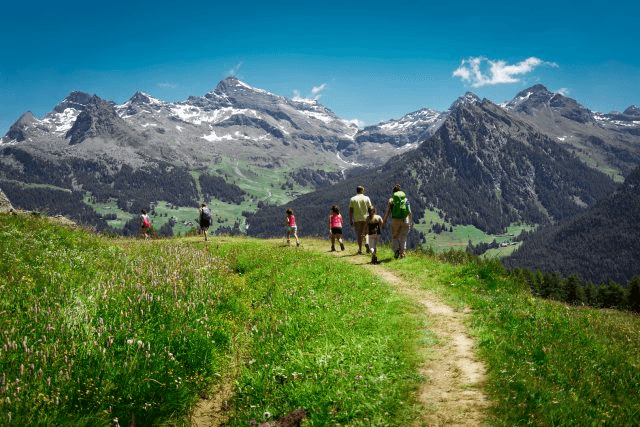
Aosta Valley measures just over three thousand square kilometres, yet within this space it concentrates a density of scenery that other alpine regions spread across entire provinces. Four massifs above four thousand metres — Mont Blanc, Monte Rosa, Gran Paradiso, the Matterhorn — frame glacial valleys, Walser pastures, border meadows and trails marked by the Italian Alpine Club for over a century. Searching online for "the most beautiful trails in Aosta Valley", however, means running into dozens of conflicting rankings: travel blogs, outdoor magazines, printed guides and Instagram posts that often repeat the same three names, without indicating difficulty, elevation gain or the season the route is passable.
We have selected ten genuinely walkable routes, featured in the Sentieri VdA catalogue, covering the entire Valdostan spectrum — from the balcony over Mont Blanc to the glacial valleys of the Gran Paradiso, from the Valpelline to the Matterhorn — avoiding duplicates and favouring scenic variety. This is not a contest of altitude: each trail here tells a different story, geological or human, and deserves at least a full day.
Every trail mentioned has a dedicated page with its CAI difficulty, elevation gain, interactive map and GPX track where available. Consult them before setting off: in the mountains, beauty and safety walk together.
Why these ten — and not others
The western Alps formed over the course of tens of millions of years through the collision between the African and European plates; Aosta Valley preserves their most legible traces: gneiss and calc-schists in the side valleys, granites on the Monte Rosa, metamorphic rocks on the Grandes Jorasses. The trails that follow are neither "the easiest" nor "the most difficult": they are the ones where landscape, accessibility and route quality converge into a memorable experience. We have included day loops, stages of great traverses and sections of international tours, because Valdostan beauty does not belong to a single type of hiker.
1. Anello del Rifugio Bonatti — the balcony over Mont Blanc
The Anello del Rifugio Bonatti trail is the classic par excellence of Val Ferret, the valley that Walter Bonatti — mountaineer, writer, explorer — chose as his home in the last decades of his life. From Lavachey, the trail climbs through larches and rhododendrons to the refuge meadow, then continues as a loop with a head-on panorama of the Grandes Jorasses, the Dente del Gigante and the Brenva glacier. Geologically, you are on the slopes of the Mont Blanc massif, where tectonic pressure has lifted metamorphic rocks that today form some of the most celebrated vertical walls in world mountaineering.
The difficulty is E (hiking), with about nine kilometres and an elevation gain manageable in half a day for fit hikers. The most important practical tip: set off early. Val Ferret is exposed to summer afternoon storms, and the return to Lavachey under the rain is not dramatic but takes away much of the pleasure. In July and August the car parks at Planpincieux and Lavachey fill up: better a Tuesday in June or a Friday in September.
Why does it stay at the top of every ranking? Because it concentrates in a few hours what many seek in a week of trekking: glaciers, north faces, alpine meadows and the sense of being "inside" Mont Blanc without tackling technical passes. If it is your first time in Val Ferret, this loop is the ideal gateway.
2. Lago Djouan — a glaciological mirror above Cogne
In Valnontey, in the heart of the Gran Paradiso National Park, the route to Lago Djouan leads to one of the most photogenic basins in the entire alpine arc. The turquoise water is not an effect of Instagram filters: it comes from the suspension of rock flour produced by the Gran Paradiso glacier that feeds the lake. Moraines, erratic boulders and, with a bit of luck, ibex nearby complete a scene that sums up the soul of the oldest park in Italy, established in 1922 to protect the alpine ibex — today the Valdostan symbol par excellence.
The trail crosses larch and Swiss stone pine woods, then opens onto the meadows of the alpine pasture. The climb is gradual, suited to families used to walking, but do not underestimate the altitude: you are above two thousand five hundred metres, and even in July a light jacket comes in handy at the lake. Bring binoculars: the park's wildlife is used to the human presence, but should be observed from a respectful distance.
Lago Djouan is a perfect destination for those visiting Cogne for the first time: it combines protected nature, a glacial landscape and an atmosphere less crowded than the trails closer to the village. Once at the basin, allow yourself at least half an hour of silence: the wind rippling the surface and the distant sound of avalanches breaking off the glacier are part of the experience.
3. Alta Via 1, Frassati–Bonatti stage — the great traverse
Stage 16 of Alta Via 1 links the Rifugio Frassati to the legendary Bonatti by crossing the Col Malatrà, one of the most scenic passes of the entire traverse that runs from Donnas to Courmayeur in fourteen stages. Here you walk on the boundary between the Valdostan side of Mont Blanc and the side valleys that look towards the Valpelline.
The difficulty is EE (experienced hikers): the elevation gain and the length of the day require fitness, suitable boots and the ability to read mountain weather. The Col Malatrà, at over two thousand nine hundred metres, can remain snow-covered until mid-July; always check the conditions on the CAI website or at the refuges. The reward is proportional to the effort: ridges, minor glaciers, views that take in Mont Blanc from an angle different from any trail in Val Ferret.
For those seeking the "great trek" of Aosta Valley, this stage is a concentrate of what Alta Via 1 has to offer: refuge infrastructure, CAI waymarks, postcard landscapes and the satisfaction of having walked a section that few day hikers dare to tackle. Book both refuges in advance: the Frassati and the Bonatti are obligatory stages for those walking the AV1 in a north-south direction.
4. Tour du Mont Blanc, Bonatti–Elena stage
On the Tour du Mont Blanc, stage 3 Bonatti–Elena descends towards Courmayeur with continuous views of the massif. It is one of the most celebrated days of the entire loop of about 170 kilometres that crosses Italy, France and Switzerland: from the Rifugio Walter Bonatti you descend through meadows and woods down to the Rifugio Elena, with the profile of Mont Blanc changing at every switchback.
The stage is E, doable in a day by fit hikers even outside the context of the full tour. Many choose it as a "taste" of the TMB: a single night in a refuge, two days of walking, the maximum panorama with a contained effort. The tip: stay overnight at the Bonatti the evening before, so that in the morning you have the grazing light on the Jorasses before starting the descent.
The Tour du Mont Blanc has existed since the post-war years as a route of European reconciliation; walking even just this section means entering a tradition that has led tens of thousands of hikers to discover that the Alps know no political borders, only ridges and valleys. Bring your passport or ID card: the trail touches border stretches, even if it does not cross checkpoints.
5. Alta Via 2, Cogne–Sogno di Berdzé stage
Stage 10 of Alta Via 2 climbs from the village of Cogne — one of the most authentic Walser centres in the region — through larch woods up to the Rifugio Sogno di Berdzé, a gateway to the high altitudes of the Gran Paradiso Park on the eastern side. The name of the refuge evokes the Valdostan tradition of the "dream" as an unreachable goal; in reality, with a well-paced day of walking, the Berdzé is a concrete and welcoming destination.
Alta Via 2 is less crowded than the AV1 and crosses wilder valleys: Valgrisenche, Rhêmes, Val Veny. This stage is the best way to enter the "AV2 world" starting from a comfortable base like Cogne, with hotels, restaurants and the chance to fall back in case of bad weather. The difficulty is E, with a sustained elevation gain but no exposed passages.
Walking among the centuries-old larches, consider that these woods are among the most southerly in Europe for this species: the continental climate of Aosta Valley preserved them while elsewhere the larch retreated. At the Berdzé, the Valdostan cuisine and the view of the Gran Paradiso peaks repay every hour of climbing. Book the refuge: in August the beds are limited.
6. Tour del Monte Rosa, Valtournenche–Champoluc stage
Stage 3 of the Tour del Monte Rosa crosses the heart of Val d'Ayas with the four-thousand-metre peaks of the massif always on the horizon. The Monte Rosa — Monte Rosa in Italian, the massif that hosts Punta Dufour, the highest peak in the western Alps — dominates every frame: glaciers, pink granite walls, hanging valleys that seem drawn by a Renaissance cartographer.
This is one of the most spectacular days of the entire loop that circles the massif through Italy and Switzerland. The difficulty is EE: high-altitude passes, possible presence of firn snow even in summer, exposure to the elements. It is not a trail for beginners, but for experienced hikers it represents the essence of "high" Valdostan trekking: a luminous, adrenaline-fuelled landscape, without compromise.
The practical tip: set off from Valtournenche in stable weather and with forecasts of at least two clear days. The Tour del Monte Rosa requires a full week; this stage, walkable even on its own with transfers organised, is the most representative of the Ayas character: Walser, mountain pasta dishes, silence above two thousand metres.
7. Tour del Gran Combin, Ollomont–Prarayer stage
In the silence of the Valpelline, one of the most austere and authentic valleys in the region, the first stage of the Tour del Gran Combin climbs to the Rifugio Prarayer with a view of the Combin massif. The Valpelline has historically been a transit valley towards the Great St Bernard and, further north, towards Swiss Valais: here the mountain conceded nothing to mass building, and the villages — Ollomont, Bionaz, Doues — preserve a rare rural character.
The Gran Combin, with its main summit at 4314 metres, is one of the most solitary four-thousanders of the western Alps: less frequented than Mont Blanc and Monte Rosa, just as majestic. The climb to the Prarayer is E, through pastures and ancient transhumance routes. The refuge is large, suited to groups, with generous cuisine and a "border" atmosphere reminiscent of the great Swiss traverses.
Why include it in a ranking of "the most beautiful"? Because it represents the Aosta Valley that many tourists do not see: no queues, no crowded cable cars, only rock, ice and the sound of glacial streams. If you seek authenticity more than comfort, the Valpelline and the Prarayer are the answer.
8. Alta Via 1, Cuney–Oyace stage
AV1 stage 11 crosses the pastures and ridges of the Valpelline at a slow pace with panoramas over the Monte Rosa. From the Rifugio Cuney — one of the most central refuges on Alta Via 1 — you descend towards Oyace, crossing a landscape of abandoned and recolonised pastures, marmots, golden eagles and, in summer, blooms that colour the meadows yellow and violet.
The difficulty is E, with ridge sections that require care in case of fog. The Cuney is an ideal base for hikes towards minor lakes and passes of the Valpelline; the descent to Oyace closes a "slow" day, far from mass tourism. Here Walser culture gives way to a more archaic Valdostan identity, made of stone houses and Franco-Provençal names.
For those seeking solitude without giving up refuge infrastructure, this stage is among the most underrated of the AV1. A tip: stay overnight at the Cuney, set off at dawn and allow yourself a long break at the Passo di Nana before the descent. The Monte Rosa, seen from this angle, has a different presence — closer, more menacing, more beautiful.
9. Alta Via 1, Vieux Crest–Grand Tournalin stage
Between Gressoney Saint-Jean and Val d'Ayas, stage 7 combines woods, Walser pastures and the summit of the Grand Tournalin as a scenic backdrop. Gressoney is one of the liveliest Walser centres in the region: the ancient German culture is reflected in the dialects, in the wooden architecture and in the gastronomic traditions that resist globalisation.
The Rifugio Vieux Crest, in wood and stone, is one of the most "character-rich" refuges on Alta Via 1: small, welcoming, surrounded by larches. The climb towards the Grand Tournalin — optional, EE — adds panorama and elevation gain; the base stage up to the refuge or beyond towards the higher altitudes is E and doable in a day. The Tournalin, at 3379 metres, offers a three-hundred-and-sixty-degree view over Monte Rosa, Mont Blanc and the Gran Paradiso.
This is one of the most "cultural" stages of the AV1: you walk not only through the landscape, but through the history of the peoples who colonised these valleys from the tenth century onwards. Once at the Vieux Crest, order a polenta concia and ask the warden to tell you the story of the name — Walser, French, Italian: at Gressoney all three coexist.
10. Tour del Cervino, Oriondé–Colle Teodulo stage
We close with stage 3 of the Tour del Cervino: ridges, glaciers and the pyramid of the Matterhorn dominating every frame. The Cervino — Matterhorn in German, an icon of the Alps — is a mountain that does not forgive mistakes: its vertical walls and unstable climate have marked the history of mountaineering since the first ascent of 1865.
The Colle Teodulo, at 3317 metres, is one of the most scenic border passes between Italy and Switzerland. The stage starts from the Rifugio Oriondé and crosses glacial and rocky terrain up to the pass, with difficulty EE: only for experienced hikers with a good stride at altitude, light crampons if the snow is hard, and orientation skills. The panorama of the Matterhorn from the south-east is different from that of Breuil-Cervinia: you will see the south face, the Cresta del Leone, the upper Verra glacier.
Why close with the Matterhorn? Because it represents the aesthetic peak of the western Alps: a form so perfect it seems artificial. Walking towards the Colle Teodulo means approaching that form with the respect it deserves. Check the condition of the glacier: in summer the route may require a guide or specific equipment.
A curious off-list itinerary
If you have already walked the classics of Val Ferret, try the Tour del Rutor, Verney–La Thuile stage: a gentle closing of the Rutor loop with minor lakes, larch woods and an end-of-season atmosphere that few tourists know. Rarely cited in the "top ten" rankings, it is ideal for a Thursday in June when Courmayeur and Cogne begin to fill up.
Valgrisenche, where the Tour del Rutor winds, is a side valley of the Dora Baltea accessible from La Thuile: glaciers, moraines, emerald lakes and a silence reminiscent of the Aosta Valley of thirty years ago. The Verney–La Thuile stage is predominantly downhill, E, and closes the circle of a tour that deserves a full week if you want to savour it calmly.
How to use this guide
Consult the linked pages for seasonality, equipment and variants. For a weekend, combine the Bonatti and Lago Djouan — two valleys, two massifs, zero overlap. For a week, choose an Alta Via or a Tour and use this list as an "anthology" of the most beautiful moments. The Valdostan mountains do not reward those who rush: they reward those who observe, stop, return.
| Trail | Difficulty | Ideal for |
|---|---|---|
| Anello Bonatti | E | First time in Val Ferret |
| Lago Djouan | E | Families, photographers |
| AV1 Frassati–Bonatti | EE | Great traverses |
| TMB Bonatti–Elena | E | A taste of an international tour |
| AV2 Cogne–Berdzé | E | Eastern Gran Paradiso |
| TMR Valtournenche–Champoluc | EE | 4000 m enthusiasts |
| Gran Combin Ollomont–Prarayer | E | Authentic Valpelline |
| AV1 Cuney–Oyace | E | Solitude |
| AV1 Vieux Crest–Tournalin | E | Walser culture |
| Cervino Oriondé–Teodulo | EE | Experts, Matterhorn |
Photo credits
Cover: Pexels — Rifugio Walter Bonatti and the walls of Mont Blanc, Val Ferret. Image at /articoli/10-sentieri-bonatti.jpg.