Trail guide
The 10 most beautiful refuges in Aosta Valley
Ranking of the ten most spectacular alpine refuges in Aosta Valley — Bonatti, Sella, Gabiet, Prarayer and more.
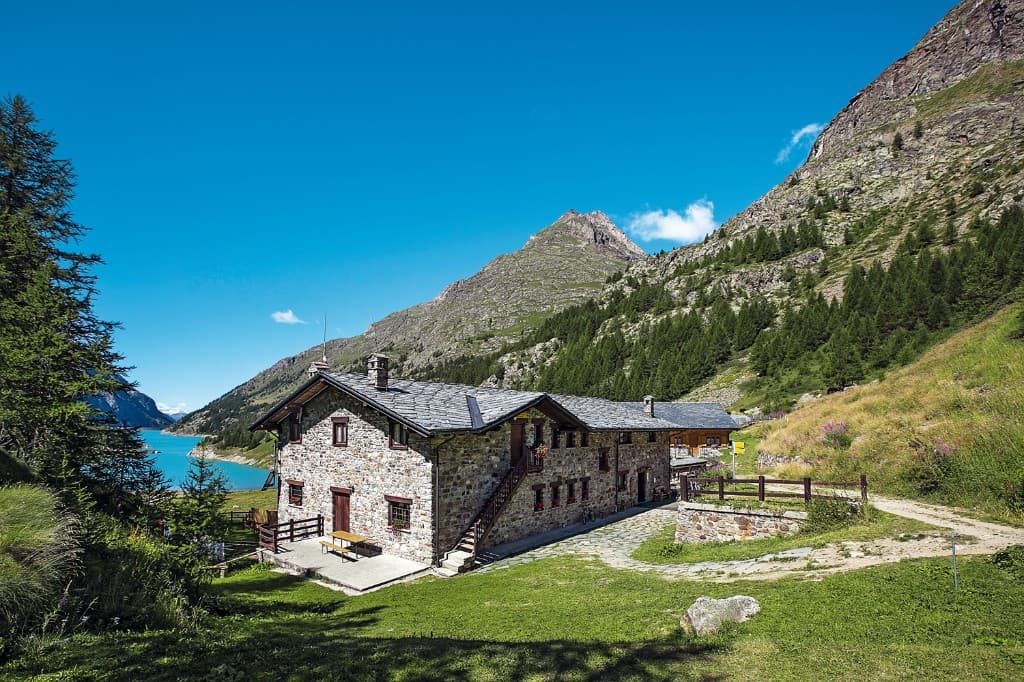
Sleeping in a mountain refuge in Aosta Valley is an experience that many blogs compare to a "hotel at two thousand metres with an IMAX view". The reality is simpler and more beautiful: wood crackling in the communal stove, a starry sky free of light pollution, dawn over the glacier filtering through the dormitory windows, the smell of polenta and soup rising from the kitchen before you have even finished lacing your boots. The Valdostan alpine refuges — run by the CAI, by local sections or by mountain families for generations — are not resorts: they are safe harbours in an environment that does not forgive improvisation.
We have selected ten refuges reachable via the trails in the Sentieri VdA catalogue, each with a different personality: absolute legends like the Bonatti, Walser gems like the Vieux Crest, temples of the Gran Paradiso like the Sella. This is not a ranking of "comfort" — beds and showers vary — but of overall experience: panorama, atmosphere, cuisine, position in the landscape.
Booking mandatory July–August at the "icon" refuges. Sleeping-bag liner everywhere. Cash for small expenses — there isn't always a card machine.
Why sleep in a refuge — and not in a hotel
A night at high altitude changes your relationship with the mountain. Setting off at dawn from Courmayeur to reach the Bonatti by lunchtime means tackling the climb with a heavy pack and returning exhausted. Staying overnight at the Bonatti means watching the sunset over the Grandes Jorasses, dining with hikers from half the world, falling asleep two hours after dusk and waking when the east face of Mont Blanc turns pink. The refuge is not a shortcut: it is a different way of walking, slower, more immersive, better suited to those who want to live the mountain and not just cross it.
1. Rifugio Bonatti — the legend
Reachable via TMB stage 2 Bertone–Bonatti, the Rifugio Walter Bonatti is the most photographed refuge in Italy for a reason that goes beyond Instagram: the wall of the Grandes Jorasses, the Dente del Gigante and the Brenva glacier are within reach — or within frame — from the terrace and the rooms. Bonatti, the mountaineer and writer who chose Val Ferret as his home, left a legacy that the refuge named after him embodies: adventure, respect for the mountain, beauty without compromise.
The stage from Bertone is E, doable in half a day by fit hikers. Book well in advance: in July and August the beds vanish, and walking up to the Bonatti only to find it "full" is guaranteed disappointment. The cuisine is solid, the atmosphere international — the TMB draws hikers from all over Europe — and dawn over the wall is worth every line of the reservation.
A practical tip: sleeping-bag liner mandatory, head torch for night-time bathroom trips, earplugs if you are sensitive to dormitory noise. The Bonatti is not silent: it is alive, as a refuge at the centre of one of the world's most famous treks should be.
2. Rifugio Vieux Crest — Walser and wood
AV1 stage 6 Gressoney–Vieux Crest leads to a refuge with a historic Walser character, surrounded by centuries-old larches and a landscape that still speaks ancient German in its place names and dialects. Gressoney Saint-Jean, an alternative starting point, is one of the most authentic Walser centres in the region: wooden houses, gastronomic traditions, a cultural identity that resists touristic homogenisation.
The Vieux Crest is "small" compared to the Bonatti: fewer beds, an authentic "mountain home" atmosphere. Difficulty E, climbing through woods and then alpine meadows. The kitchen offers Valdostan and Walser dishes; the warden often tells the story of the name — "vieux crest" evokes the old ridge, the boundary line between valleys. Staying here means entering a world that the mass tourism of Courmayeur does not offer.
Ideal for families who want to sample Alta Via 1 without EE stages, and for those seeking silence in September when Gressoney empties and the larches begin to turn. Book all the same: the Vieux Crest has few beds and many devotees who return every year.
3. Rifugio Cuney — the heart of Valpelline
With AV1 stage 10 Barmasse–Cuney you reach one of the most central refuges on Alta Via 1, a base for ridges, minor lakes and traverses towards the Valpelline. The Cuney sits in a strategic position: from here, variants set off towards passes and basins that few day visitors ever see. The Valpelline — an austere, authentic valley far from the queues — works its way into the preferences of hikers who have already "done" the Bonatti and the Sella.
The difficulty is E, with the elevation gain spread over a day. The refuge is CAI-run, an essential but welcoming environment. The kitchen makes the most of local products; the view over the Monte Rosa and the side valleys repays the effort. A tip: stay two nights if you can — one to arrive, one to explore day variants towards lakes and passes without a heavy pack.
The Cuney represents the "traverse" refuge: not an end in itself, but a stage on a longer route. If you are planning the full AV1, mark it down as one of the most underrated stages — panorama, silence, perfect position in the heart of the region.
4. Rifugio Gabiet — gateway to Monte Rosa
The first stage of the Tour Monte Rosa, Gressoney–Gabiet offers dinner with a view of the four-thousanders of Monte Rosa — Punta Dufour, Lyskamm, Castore — and a relatively gentle approach compared to other stages of the tour. The Gabiet is the "entrance gate" to the massif: from here, hikes set off towards lakes, passes and, for the more experienced, variants towards higher altitudes.
Difficulty E, suited to families who want to sample high altitude without EE. Gressoney Saint-Jean offers connections, car parks and services. The climb to the Gabiet crosses woods and meadows; the refuge, spacious, welcomes groups and school parties from the Ayas valley. The cuisine is generous — important after a day at altitude with children.
Why the Gabiet in a ranking of "the most beautiful"? Because it concentrates in a single overnight stay what many seek on the Tour del Monte Rosa: 4000 metres on the horizon, a Walser atmosphere, family infrastructure. Book for July–August; in June and September you will find more availability and clearer light.
5. Rifugio Duca degli Abruzzi — kingdom of the Matterhorn
Tour Cervino stage 1 Breuil–Duca Abruzzi climbs to the foot of the most iconic pyramid in the Alps. The Cervino — the Matterhorn — dominates every window, every terrace, every photograph. The Rifugio Duca degli Abruzzi, dedicated to the mountaineering prince who first attempted the Italian route on the south face, is "picture-postcard" in the best sense: a unique position, mountaineering history, a panorama that needs no filters.
The difficulty is E/EE depending on the variants; the base stage from Breuil-Cervinia is among the busiest of the tour. Booking is essential: the Matterhorn draws tourists from all over the world and the beds at the Duca Abruzzi are limited. Dinner with a view of the south face — Cresta del Leone, the upper glacier — is an experience that alone justifies the Tour del Cervino, even just for this stage.
A tip: bring binoculars to watch the climbers on the wall (from a safe distance). Do not underestimate the altitude: you are above two thousand five hundred metres; altitude sickness is rare but possible. Acclimatise with a day in Breuil before the climb if you are coming from the valley floor.
6. Rifugio Deffeyes — Valgrisenche
Tour Rutor stage 1 La Thuile–Deffeyes is a base for the Rutor lakes, glaciers and the glacial environment of Valgrisenche. The Deffeyes — family-run, with authentic Valdostan cuisine — represents the "side-valley" refuge: less famous than the Bonatti, just as essential for those walking the Tour del Rutor or seeking access to the emerald lakes of the area.
Difficulty E, with the climb from La Thuile through woods and then moraines. The refuge sits in an ideal position for the next stage towards Lago Rutor — one of the most spectacular lakeside destinations in the region. A welcoming environment, often less crowded than the Mont Blanc refuges. Book all the same in August: the Tour del Rutor has its devotees.
Valgrisenche is a valley bordering France, historically linked to hydroelectric power and to seasonal livestock movements. Staying overnight at the Deffeyes means entering a world different from Courmayeur — quieter, more glacial, more "Nordic". Bring warm layers: the nights in a side valley can be cool even in July.
7. Rifugio Prarayer — Gran Combin
With Tour Gran Combin stage 2 Prarayer–Col Gran San Bernardo you cross an austere and fascinating landscape beneath the Combin massif. The Prarayer — large, suited to groups — is a base for traverses towards the Great St Bernard and for hikes towards the higher reaches of the Combin. Here the Valpelline shows its wildest face: dark rock, minor glaciers, silence.
The stage leading to the Prarayer (stage 1 Ollomont–Prarayer) is E; the following stage towards the Col Gran San Bernardo is EE. Staying overnight at the Prarayer lets you tackle the second day fresh, or explore day variants if you are not completing the tour. Generous cuisine, a "border" atmosphere reminiscent of the Swiss refuges of the Valais.
Why include the Prarayer? Because it represents the Aosta Valley that few people see: no crowded cable cars, no queues, just real mountains. If you have already slept at the Bonatti and the Sella, the Prarayer completes the picture with a different identity — more austere, just as authentic.
8. Rifugio Chalet de l'Épée — Rhêmes
AV2 stage 6 Chalet Épée–Rhêmes Notre Dame leads to a refuge in the heart of the wildest valley of Alta Via 2. Rhêmes Notre Dame — "Notre Dame des Neiges" — is one of the most isolated villages in the region: few inhabitants, dominant nature, trails that seem never to end.
The Chalet de l'Épée takes its name from the shape of the mountain above it; the management is welcoming, the cuisine Valdostan. Difficulty E, a traverse stage or a destination for day hikes from the valley. Silence guaranteed in September, when the AV2 empties and the larches turn yellow.
Staying overnight at the Épée means entering the "eastern Gran Paradiso": glacial valleys, ibex, landscapes that the photographer Vittorio Sella documented in the late nineteenth century. Combine it with the stage towards Eaux Rousses or towards the Sella for a "slow" weekend in the park. Booking recommended even outside August: beds are limited and demand is growing.
9. Rifugio Frassati — Great Saint Bernard
AV1 stage 15 Saint-Rhêmy–Frassati combines the history of the alpine crossing with generous cuisine. The Frassati lies on the slope of the Great Saint Bernard — the historic transit pass between Italy and Switzerland — in an area of pastures and ridges that the AV1 crosses at a slow pace. Often underrated compared to the Bonatti, it is a "transition" stage that surprises with its hospitality and panorama.
Difficulty E, with the climb from Saint-Rhêmy-en-Bosses through woods and then alpine pastures. The refuge is dedicated to Pier Giorgio Frassati, patron of hikers: a particular atmosphere, often with youth groups and families. The cuisine is among the most appreciated on the AV1 — important after days of traversing.
A tip: if you walk the AV1 in a north-south direction, the Frassati comes after demanding stages: allow yourself rest and a good dinner. If you reach it on a day hike from Saint-Rhêmy, combine it with a visit to the nearby Great St Bernard Pass — history, Barry dogs, the border.
10. Rifugio Vittorio Sella — temple of the Gran Paradiso
AV2 stage 8 Eaux Rousses–Sella leads to one of the symbolic refuges of the Gran Paradiso National Park, surrounded by glacial valleys, ibex and landscapes that the photographer of the same name immortalised in platinum prints that today document the retreat of the glaciers. The Sella is not just a refuge: it is a temple — a pilgrimage destination for hikers who know the history of mountaineering and of alpine conservation.
Difficulty E, an AV2 traverse stage or a destination from Eaux Rousses. Booking mandatory July–August: the Sella is among the most sought-after refuges in the park. Its position, dominant over valleys and peaks, offers memorable sunrises and sunsets. The wildlife — ibex above the moraines — is part of the experience: observe without approaching.
Why close with the Sella? Because it represents the essence of the Valdostan alpine refuge: not luxury, but beauty, history, a respectful relationship with the mountain. After the Bonatti (the legend of Mont Blanc) and the Frassati (spirituality), the Sella restores the silence of the Gran Paradiso — and the awareness that these places are to be protected, not just photographed.
Practical tips for a night in a refuge
- Booking: mandatory July–August at the Bonatti, Sella, Elisabetta, Duca Abruzzi. Use the CAI websites or the refuges' phone lines; do not rely on "we'll see".
- Sleeping-bag liner everywhere — an alpine standard, no exceptions.
- Head torch for night-time bathroom trips and moving around the dormitory.
- Cash for extra consumption; a card machine is not guaranteed above two thousand metres.
- Earplugs and an eye mask if you are sensitive: shared dormitories are lively.
- Respect: meal times, silence after 22:00, rubbish bags carried back down to the valley.
A "surprise" refuge off the ranking
AV2 stage 7 Rhêmes–Eaux Rousses crosses little-frequented high-altitude pastures between Rhêmes Notre Dame and Eaux Rousses. Stay overnight at the Rifugio Chalet de l'Épée — already mentioned — or continue towards the Sella for a "slow" weekend in the eastern Gran Paradiso: two nights, three valleys, zero queues. An E stage, ideal for those who have already slept in the "icon" refuges and seek authenticity without giving up the panorama.
| Refuge | Approx. altitude | Booking |
|---|---|---|
| Bonatti | 2025 m | In advance |
| Vieux Crest | 1950 m | Recommended |
| Cuney | 2650 m | Recommended |
| Gabiet | 2375 m | Recommended |
| Duca Abruzzi | 2802 m | Mandatory |
| Deffeyes | 2484 m | Recommended |
| Prarayer | 2005 m | Groups |
| Chalet Épée | 2566 m | Recommended |
| Frassati | 2600 m | Recommended |
| Vittorio Sella | 2584 m | Mandatory |
Photo credits
Cover: Unsplash — Alpine refuge in stone and wood, a Valdostan mountain setting. Image at /articoli/rifugio-alpino.jpg.